INDIGENOUS PATHWAY TO SUSTAINABILITY

OUR BEES
At Mills Farm, we are proud to support Hua Parakore (Pure Products), the Māori organic verification system that upholds indigenous values of sustainability and environmental care.
Grounded in traditional Māori wisdom, Hua Parakore promotes pure, natural, and holistic bees production, ensuring that the way we grow bee swarm and queen bees nurture both the environment and our communities.
By embracing this indigenous approach, we contribute to safeguarding ecosystems, protecting biodiversity, and building a sustainable future for generations to come.
All Mills Farm products are Hua Parakore verified, reflecting our commitment to sustainable, ethical farming practices.
Find out more about Hua Parakore – Pure products
ORIGIN
The bees found in Far Northland are not native to the area. As in the rest of New Zealand, they were introduced by European settlers in the 19th century.
Over time, several European strains were imported:
- Apis mellifera mellifera — European black bee (origin: England, Germany, Scandinavia).
- Apis mellifera ligustica — Italian bee (introduced around 1880–1900).
- Apis mellifera carnica — Carniolan bee (Central Europe and the Balkans, introduced later).
Today, Northland’s bee populations are therefore mixed, but often dominated by lines descended from the Italian bee, which is gentler and more productive.
APIARIES
The warm, humid climate of the Far North is conducive to beekeeping, particularly for the production of mānuka honey, which comes from Leptospermum scoparium, a native shrub.
Our apiaries are the result of 180 years of natural selection, successive introductions, crossbreeding, and adaptation to a unique environment.
Our hives in Northland still house ancient strains, considered to be local populations well adapted to the conditions of the region. (native flora, subtropical climate, etc.).
DESCRIPTION
The honeybee populations (Apis mellifera) in Far North, although artificially introduced, now exhibit interesting genetic diversity, resulting from crossbreeding between different European breeds adapted to local conditions.
- Apis mellifera mellifera (European black bee): Initially dominant, now in decline or crossed with other strains.
- Apis mellifera ligustica (Italian honeybee): Currently dominant in commercial breeding. It is the main strain used by New Zealand beekeepers.
- Apis mellifera carnica (Carniolan honeybee): Less common than ligustica, but present in our apiaries due to the Honeymoon valley, Peria local carnolian specialised breeding programmes and crossbreeds for the last few decades.
BEHAVIOUR
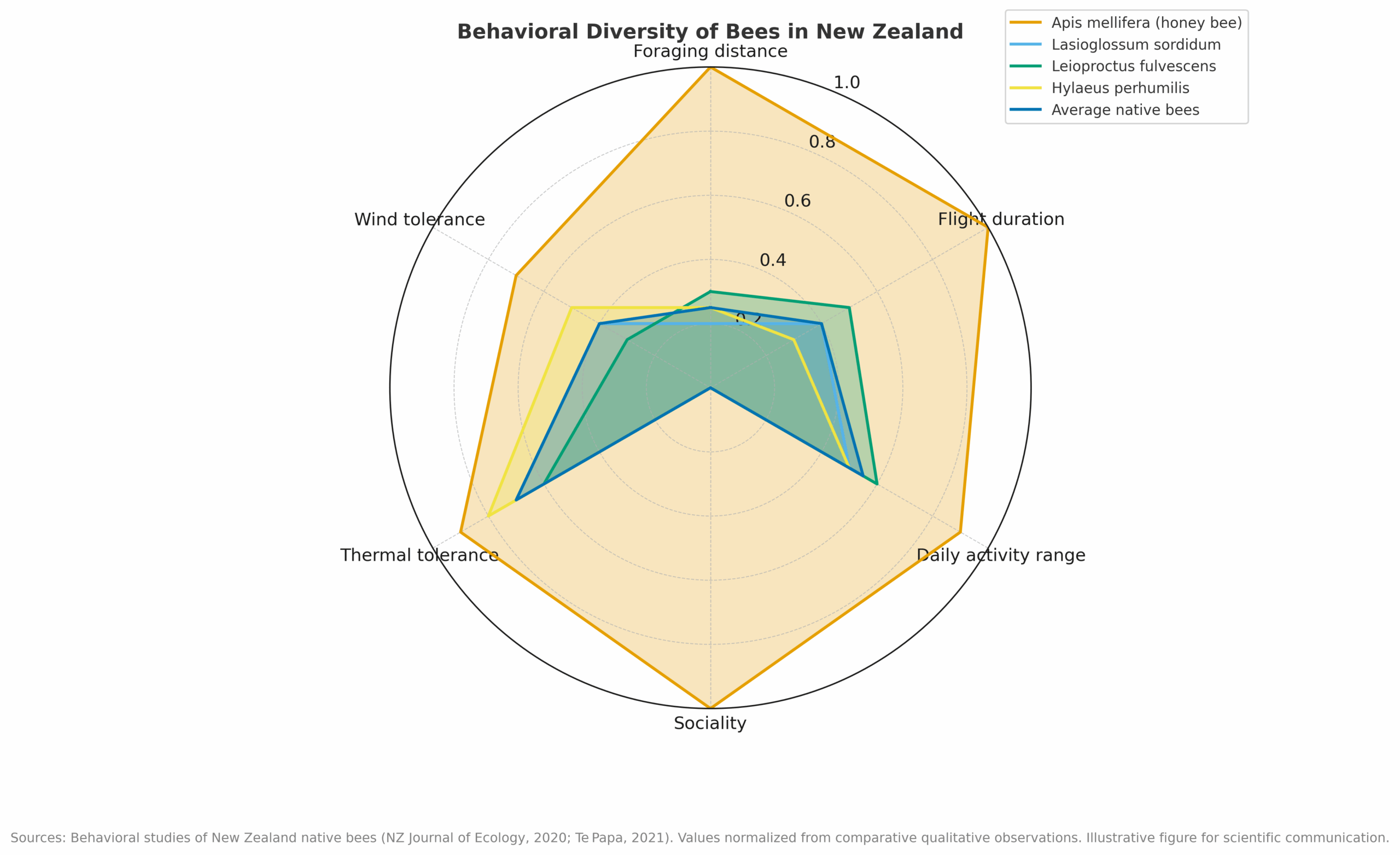
This radar chart here after illustrates the comparative behavioral diversity among honey bees (Apis mellifera) and several native bee species in New Zealand, including Lasioglossum sordidum, Leioproctus fulvescens, and Hylaeus perhumilis.
Traits such as foraging distance, flight duration, daily activity range, sociality, thermal tolerance, and wind tolerance were normalized on a 0–1 scale based on relative observations reported in ecological studies.
NZ Apis mellifera shows the highest overall behavioral capacity, with extended foraging distances, long flight durations, and broad thermal tolerance, reflecting its strong adaptability and social organization.
In contrast, native bee species display lower foraging and flight capacities but moderate thermal tolerance, indicating efficient specialization in localized habitats.
The “Average native bees” polygon summarizes the general behavioral profile of New Zealand’s solitary native bee fauna, highlighting their ecological importance and niche differentiation relative to managed honey bees.
Sources: NZ Journal of Ecology (2020); Te Papa Museum Bee Behavior Notes (2021); Auckland Council Bee Management Reports (2022).
Values are illustrative and normalized for comparative visualization.