R&D International Partnership 2025-2027

Mills Farm™ launches a Research and Development program with APISELECT beekeeping operation on Yeu island, Britany, France.

As part of a collaborative trip on innovative biodynamic queen rearing techniques and methods in New Zealand from November to December 2024, Mills Farm invited APISELECT to the “land of the long white cloud” (Te tai tokerau) to launch a 2025-2027 R&D program.

The aim of this project is to validate the ancestral Maori working methods, Te waka kai ora, with biodynamic methods to show the similarities in the use of cosmic calendars and the fundamental principles of bee colony management that respects life and biodiversity. This work, initially planned to last 12 months from September 2025, is also being set up for the research and development of pharmaceutical and cosmetic products made from bee venom, in particular thanks to melittin.

Ruchers de Mill's farm sur la côte Nord-Est de l'île du Nord.

A hundred years ago, biodynamics took off in the heart of Europe. The plants specified by Steiner for making the preparations are common on the Old Continent, but unsuitable for other climates. APISELECT’s challenge was therefore to identify the biodynamic issues involved in breeding queen bees in a distant territory, preferably in the southern hemisphere, in order to validate the work on biodynamic bee management.

In New Zealand and Australia, since the 2000s, the industrialization and financialization of beekeeping linked to Manuka honey (tea tree) have shown the limits of commercial bee farming. Despite their isolation due to their insularity, colony mortality, brood diseases, and varroa mites are even more devastating today than in Europe. Beekeepers are also losing control of their apiaries to numerous financial investors who see only the profitability of Manuka honey on world markets. The purpose of this work is therefore to consolidate defenses against any form of neo-colonialism that destroys the ancestral knowledge that was forgotten before European bee varieties were imported into these territories.

In New Zealand, thanks to the Waitangi Treaty recognizing the rights of Maori culture, the techniques and methods of land and life management, “Hua Parakore,” recognized for millennia in this remote territory, are still practiced today.

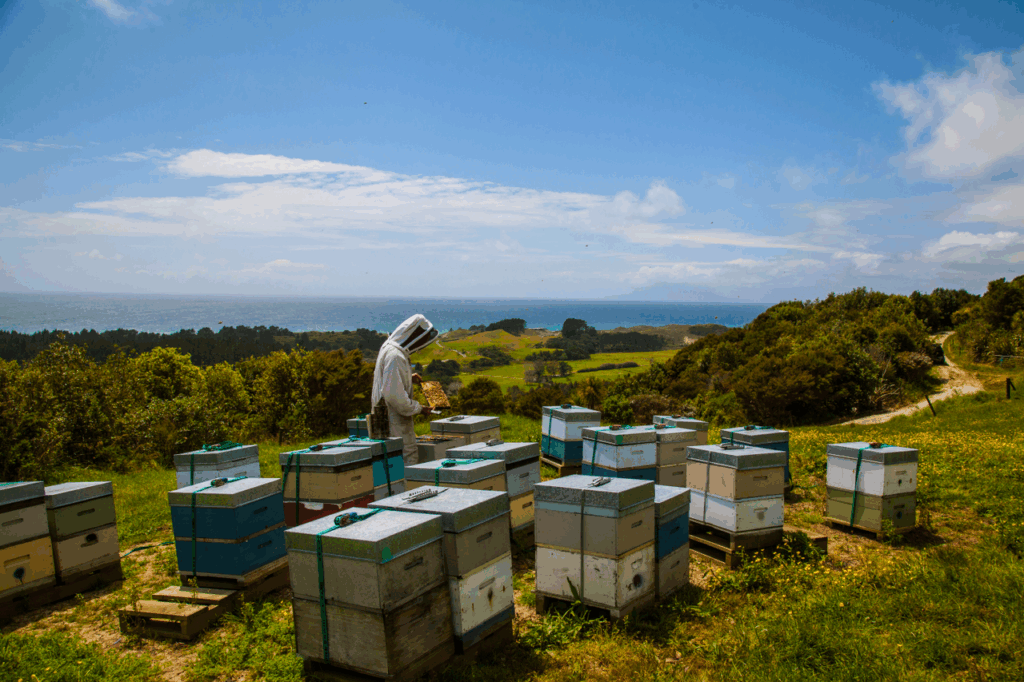
APISELECT is therefore committed to working from September 2025 to February 2026 in New Zealand with Mill’s Farm to set up a biodynamic/Hua Parakore breeding and training station. My selection and breeding work should enable the introduction of working methods that respect life and biodiversity, guaranteeing organic and Hua Parakore-certified bee venom in New Zealand and on the global pharmaceutical and cosmetics markets.

 The 2025 season in France will therefore end earlier, at the end of August, in order to winterize the hives and ensure the continuity of breeding on the Île d’Yeu for the 2027 season.